How to Package Handmade Soap for Retail and Online Orders
By Saponixsoap
Handmade soap packaging has two jobs that often need different solutions. The retail pack presents the bar and carries its information. The shipping pack protects that retail unit while it travels. Choosing a beautiful wrapper first and trying to make it perform both jobs can leave a brand with scuffed bars, damaged corners or packaging that is awkward to assemble.
Start with how customers will encounter the soap. A bar displayed on an open shop shelf needs different protection from one placed in a parcel beside several other products. The same soap can use a consistent retail identity across both channels, with additional protection for delivery.
Choose how much of the bar customers should see
| Packaging format | What it does well | What needs attention |
|---|---|---|
| Paper band | Leaves much of the soap visible and provides a compact printed area | Exposed edges, handling marks and limited space for information |
| Full wrap | Covers the bar and gives the design more continuous surface area | Fold quality, closure, contact marks and the barrier properties of the actual material |
| Folding carton | Creates clear front and back panels and protects the retail presentation | Internal fit, corner protection and whether an inner wrap is also needed |
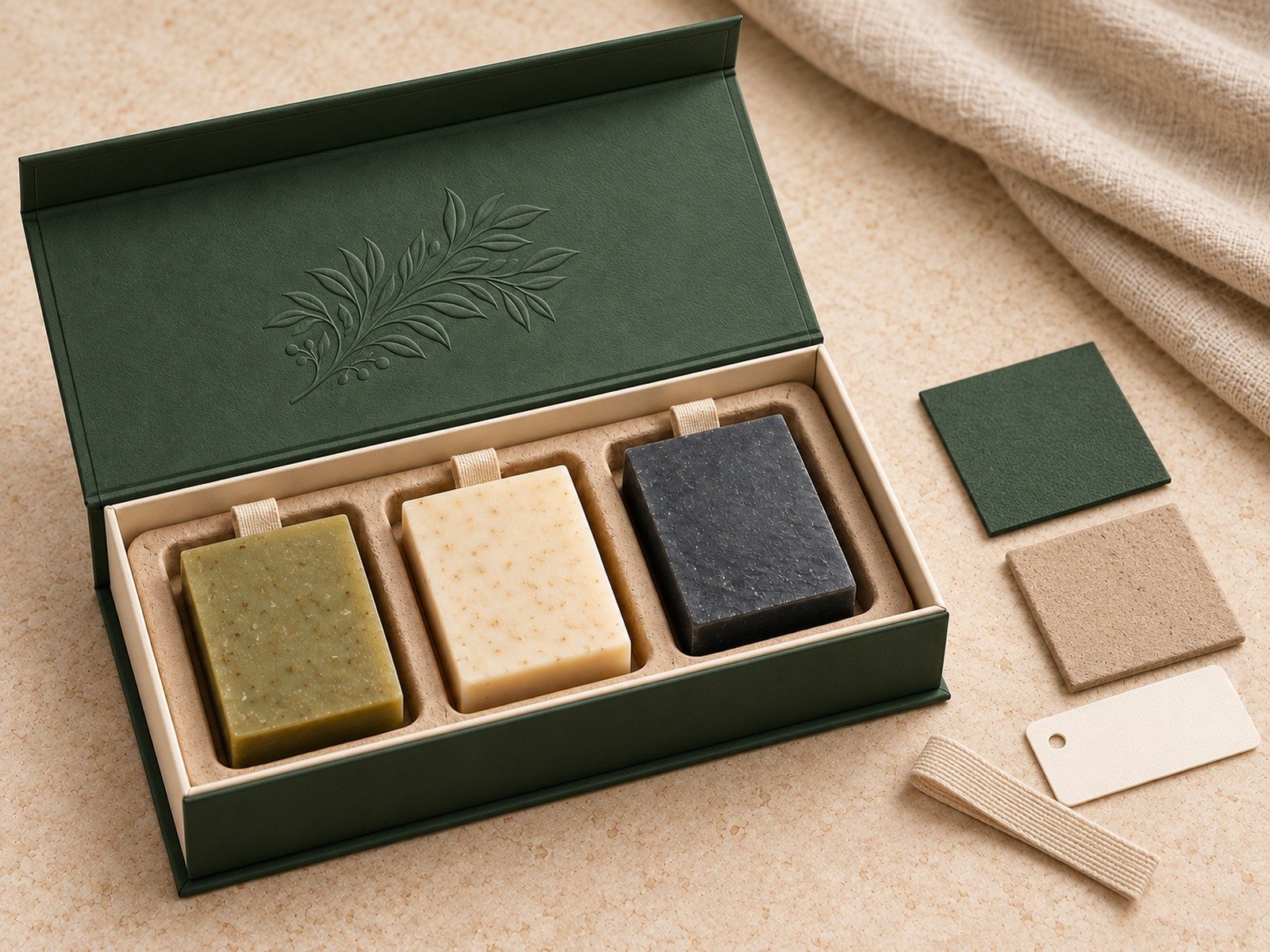
| Presentation box | Holds an arrangement of bars and supports a gift experience | Product movement, insert fit, assembly work and the size of the shipping unit |
A paper band can suit a bar whose texture or colour is important to the display. It also leaves the soap exposed to customers’ hands and surrounding products. Where that exposure is unsuitable, a wrap or carton may be a more practical retail format.
A windowed carton offers a partial view, but the opening changes the protection available. Check where the soap touches the carton and whether customers can press on the exposed surface. The presence of a window does not settle the need for an inner wrap.
Match packaging to the condition of the finished soap
Cold process describes a manufacturing method; handmade describes how a product is made more broadly. Neither term tells a buyer exactly when a particular bar is ready to pack. Packaging decisions should use the finished product at the intended packing stage.
A bar that is still changing in size or losing moisture can fit differently later. Surface moisture in humid conditions can also affect a wrapper or label. These issues need to be checked on the proposed formula and material combination rather than solved by choosing a package that looks more natural.
Some paper has a coating or lining, while other paper offers little resistance to moisture or oil contact. A kraft appearance does not reveal that construction. Request the material specification and evaluate the soap in contact with it. This is more useful than assuming that all paper lets a bar breathe or that every film behaves as a complete barrier.
Run a simple packaging comparison before ordering print
Prepare several bars of the same product in each proposed format. Keep a reference bar and record the packing date, storage conditions and material used. At agreed review points, compare visible marks, closure, label adhesion, fragrance and the ease of removing the soap.
Place a light-coloured sheet inside one sample pack if it helps reveal contact marks. Open and close a carton several times to see whether the flaps remain usable. Check the result after realistic handling, not only immediately after assembly.
This is an initial selection exercise. A short observation at room conditions cannot establish shelf life or simulate every destination climate. Use it to identify which material combinations deserve further packaging or stability evaluation.
Give online orders a separate protective layer
A folding carton can arrive damaged even when the soap inside is intact. In an online order, the retail pack may need spacing, cushioning or a suitably fitted outer carton to stop it moving against other items.
Pack the actual assortment intended for sale. A single bar in a small mailer and a six-bar order in a larger carton create different movement and loading conditions. Look for the areas most likely to rub or take pressure, including raised decoration and projecting corners.
A trial shipment through the expected route can reveal handling problems. It remains one observation, rather than proof that every parcel will arrive undamaged. When shipping performance is important, agree an appropriate evaluation with the packaging or logistics provider.
Keep a range consistent without making every pack identical
A brand can use one carton structure for bars with compatible finished dimensions, then distinguish fragrances through artwork. That can simplify the visual range and packing routine. If one bar is substantially thicker or has a raised top, a shared carton may need adjustment or a different fit.
Think about the person packing orders. A format that requires careful alignment, several folds and an extra seal adds handling steps for every bar. Compare an assembled sample and its packing sequence alongside the printed appearance.
For multi-bar presentations, explore the Saponixsoap soap gift set references. For a single-bar project, share the finished bar dimensions, sales channel and packaging reference through the inquiry page. The choice should protect the product while making the brand easy to recognise.