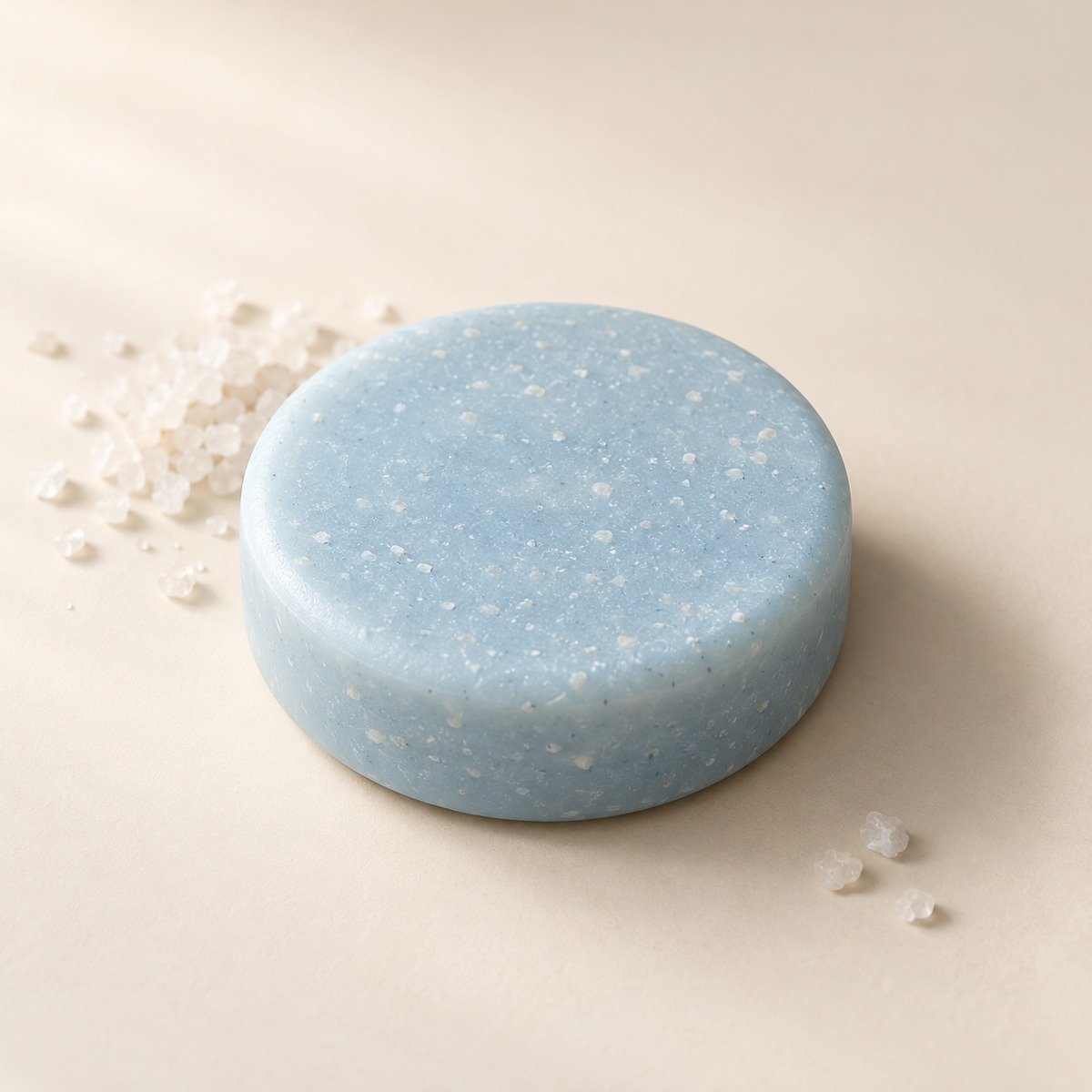
Sea Salt Soap and Salt Scrub Bars for Private Label Brands
By Saponixsoap
Sea salt soap does not describe one fixed texture. Salt may be dissolved in the formulation, dispersed as particles or used as visible decoration. A salt scrub bar usually suggests a textured product experience, but the name still does not tell a buyer how the finished bar will feel during use.
Choose whether the product should lead with a salt ingredient story, a particular texture or a spa-style presentation. Each direction changes the sample and packaging brief.
Identify the role of the salt
| Salt format | What it changes in the brief | What to evaluate on the sample |
|---|---|---|
| Dissolved salt | Ingredient identity without a promise of visible grains | Overall bar texture, lather and handling |
| Dispersed fine particles | A potentially textured surface through the bar | How evenly particles are distributed and exposed during use |
| Larger visible crystals | A pronounced visual or surface feature | Protruding edges, particle shedding and packaging contact |
| Salt decoration on the top | A particular display surface | How the decoration holds during handling and changes after wetting |
The finished texture depends on processing, particle distribution and bar wear. An ingredient photograph cannot establish how salt will become exposed at the soap surface.
If a product will be described as exfoliating, evaluate the actual finished bar for that intended use. Increasing the amount or size of visible salt for a more dramatic photograph does not establish a better product experience.
Compare texture through use as well as when dry
A new bar can have a smooth outer surface while particles become more noticeable after repeated wetting. Another design may have a decorated top that changes quickly during use. Keep a dry display reference alongside a sample used under the proposed evaluation routine.
Record where the texture appears, whether particles detach and how easy the bar is to hold. Observe the condition of the soap dish and packaging after contact. These details help distinguish an attractive display feature from one that becomes inconvenient in everyday handling.
Use a suitable, agreed product-evaluation method. Sharp or uncomfortable surface features should prompt review of the design and formula. They should not be treated as proof that a scrub is more effective.
Assess lather as part of the complete formula
A salt ingredient does not establish how much lather a bar will produce or what the foam will feel like. The cleansing base and the rest of the formula matter. Water conditions and the method used to generate foam also affect a comparison.
Place the samples under the same conditions and record the result in descriptive terms. Useful observations include how quickly foam appears, whether it has large bubbles or a denser appearance, and how the bar behaves after draining. A photograph of abundant foam taken under different conditions is a weak basis for choosing between formulas.
Keep performance language close to what has been established for the product. The presence of salt does not, by itself, substantiate detoxifying, therapeutic or mineral-delivery claims.
Select a shape that works with the intended surface
A flat face leaves space for a clear logo and close contact with a wrapper. A ridged or decorated face creates a different handling and packing requirement. Raised particles can rub against printed surfaces or need clearance inside a box.
For a spa-style range, coordinate the bar’s shape, colour and fragrance around the intended presentation. An ocean-inspired appearance can be a design direction without becoming a claim about salt origin. If a specific geographical salt source is part of the proposition, the material sourcing information must support it.
A bar designed primarily for gift display still needs to be practical to remove from its package. Review the clearance around textured surfaces so that the customer does not have to scrape the product past a tight insert.
Evaluate humidity and packaging together
Surface moisture can become a presentation problem for some salt-containing formulas in humid conditions. The actual response depends on the formula, storage environment and pack. Do not assume that a paper sleeve, carton or transparent wrap will be suitable from its appearance alone.
Compare proposed packaging with the finished bar under relevant storage conditions. Look for damp areas, paper marks, closure problems, changes in visible crystals and fragrance differences. Keep an unpacked reference where appropriate so that changes can be interpreted.
An initial observation helps select candidates; it does not establish long-term stability or transport performance. The evaluation needs to match the destination and expected product life before those claims are made.
Develop a salt soap concept with a clear purpose
Describe the intended texture, shape, fragrance and pack. A smooth salt-containing bar and a visibly textured body bar are different briefs; specify the experience you want to develop.
Explore the Saponixsoap sea salt soap reference and shape options. To discuss a concept, send the texture you want customers to experience and the presentation you have in mind through the inquiry page.